Where is my sewer line is not a question most Austin homeowners ask until something forces it. A backup at a ground-floor fixture, a service technician asking for cleanout access, or a landscaping contractor about to dig near the foundation are the events that typically prompt the question. By that point, the answer either already exists or needs to be established quickly under conditions where time and options are both limited.
A sewer line is the single buried pipe that collects combined wastewater from every toilet, sink, shower, and drain connection in a building and carries it outward to the public sewer system at the property boundary. Its defining characteristic is that it serves the entire household at once. A restriction inside it does not slow one drain while others remain functional. It reduces total system capacity and registers as slow drains, gurgling sounds, or backups across multiple fixtures simultaneously, often in different areas of the property.
At EZ Hydro Jetting Austin, we establish sewer line location and access conditions before recommending any main line service. Understanding where is my sewer line is and confirming the interior condition of the pipe are the same diagnostic step when a camera inspection handles both, and every service recommendation we make follows from what that inspection shows rather than from a phone description of how the drain has been performing.
Where the Sewer Line Runs in a Typical Austin Property
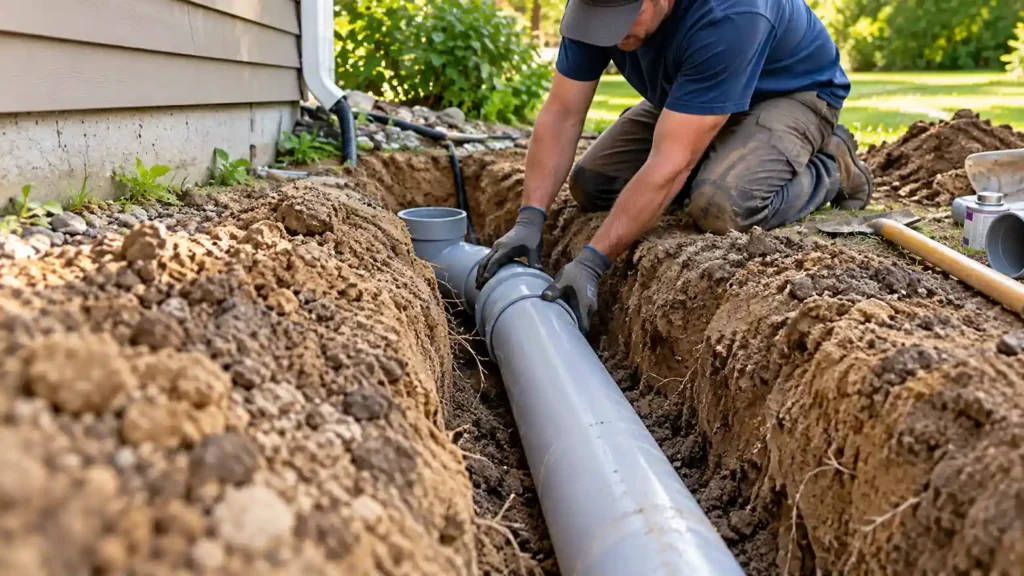
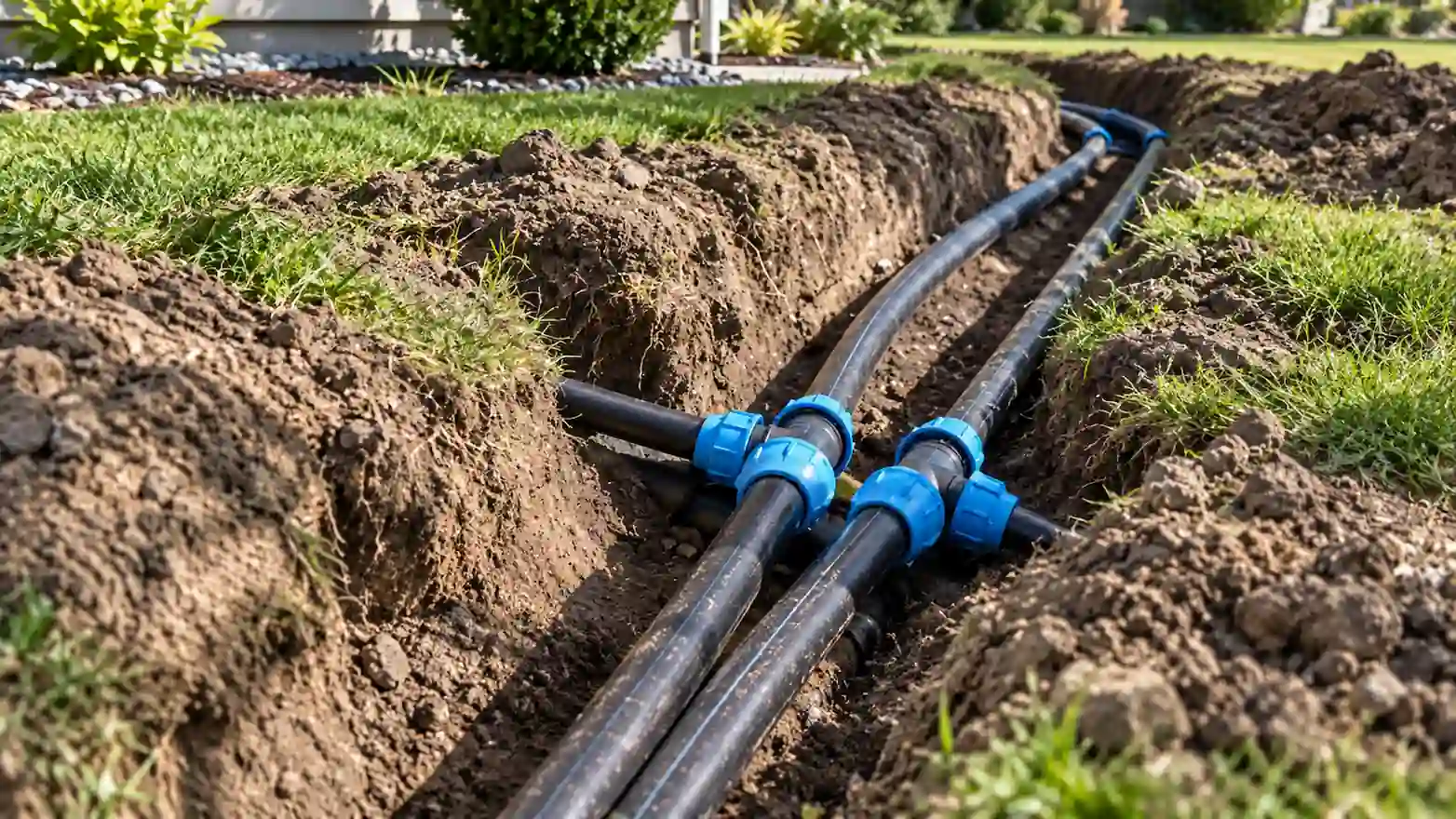
In most Austin residential properties, the sewer line exits the building through the foundation, runs beneath the yard at a consistent downward grade, and connects to the public sewer main near the street or the alley at the rear of the lot. In slab-foundation homes, which represent the majority of Austin residential construction built after the early 1960s, the pipe runs beneath the concrete slab and exits through the perimeter.
The grade of the line is not incidental. Sewer lines require a minimum downward slope to maintain self-cleaning flow and prevent solids from settling inside the pipe. When soil movement, foundation settling, or improper original installation disrupts that grade, low points develop where material collects regardless of how frequently the line gets cleaned. Those low points show up on camera as pipe bellies with standing water and accumulated sediment, and they explain recurring service calls on lines that appear to clear but back up again on a shortened interval.
The yard topography in many Austin properties provides a visual clue to the sewer line path before any inspection begins. The line follows the natural downward slope of the lot where possible, and the low point of the yard tends to align with the buried pipe in properties where the original grading was not significantly altered after construction. That topographic relationship is not a precise locating method, but it narrows the search area meaningfully before probing or camera work begins.
The Cleanout: The Most Direct Answer to Where Is My Sewer Line
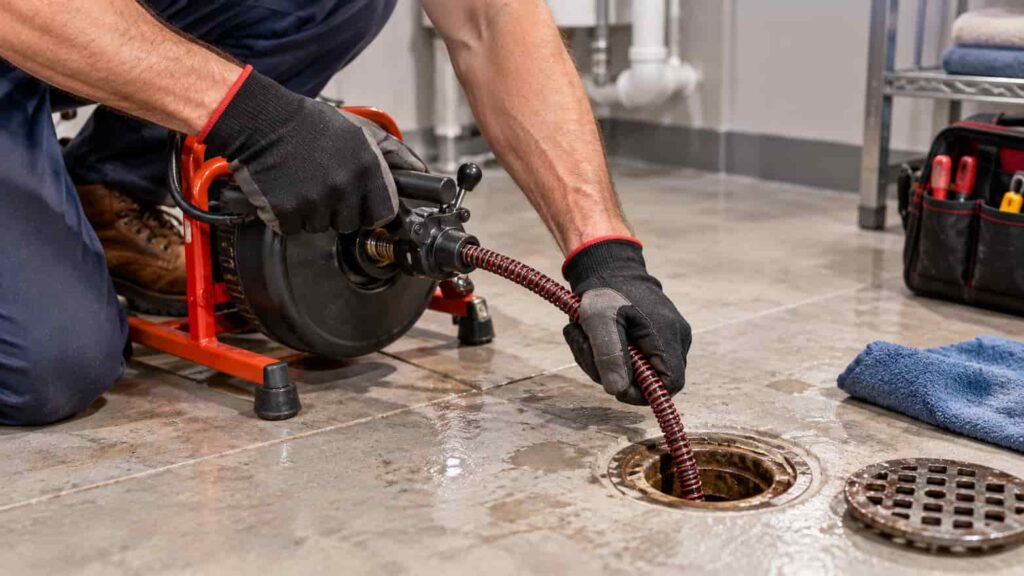
The cleanout is the access point that translates the abstract question of where is my sewer line into a practical, serviceable location. It is a capped pipe fitting, typically three to four inches in diameter, positioned at or near grade level to allow a camera, a jetting nozzle, or a snake to enter the main sewer line without removing a fixture or opening the yard. Finding the cleanout is the most direct answer to where is my sewer line for the purpose of scheduling any professional service.
Inside the building, the cleanout most commonly sits near the base of the lowest bathroom or utility connection, at the base of a main plumbing stack, or near an exterior wall in a utility or laundry area. Its position inside the house marks the upstream end of the main sewer line and establishes the direction the pipe exits the foundation, which is the starting point for tracing the line across the yard toward the street.
Outside the building, a secondary cleanout typically sits somewhere between the foundation and the street along the line’s path through the yard. The City of Austin requires this fitting for residential sewer laterals at or near the property boundary, and its location marks the downstream end of the property’s line before it joins the public main. Locating both fittings together maps the full path of the sewer line across the property and answers where is my sewer line is comprehensively without requiring a camera or a soil probe.
Where Is My Sewer Line When No Cleanout Appears on a Walkthrough
A cleanout that does not surface during an interior and exterior walkthrough is not necessarily absent. In Austin properties built before the 1970s, original cleanout fittings installed at grade level have frequently been covered by decades of soil accumulation, landscaping changes, and yard amendment that raised the surrounding grade above the fitting.
Probing the soil along the foundation line in the direction the main drain exits the lowest bathroom is one straightforward method for locating a buried fitting without opening the full yard perimeter. The probe produces a distinct resistance when it contacts the fitting rather than continuing into undisturbed soil. In properties with original cast iron infrastructure, a metal detector locates buried caps efficiently by detecting the ferrous material beneath the soil surface without physical probing.
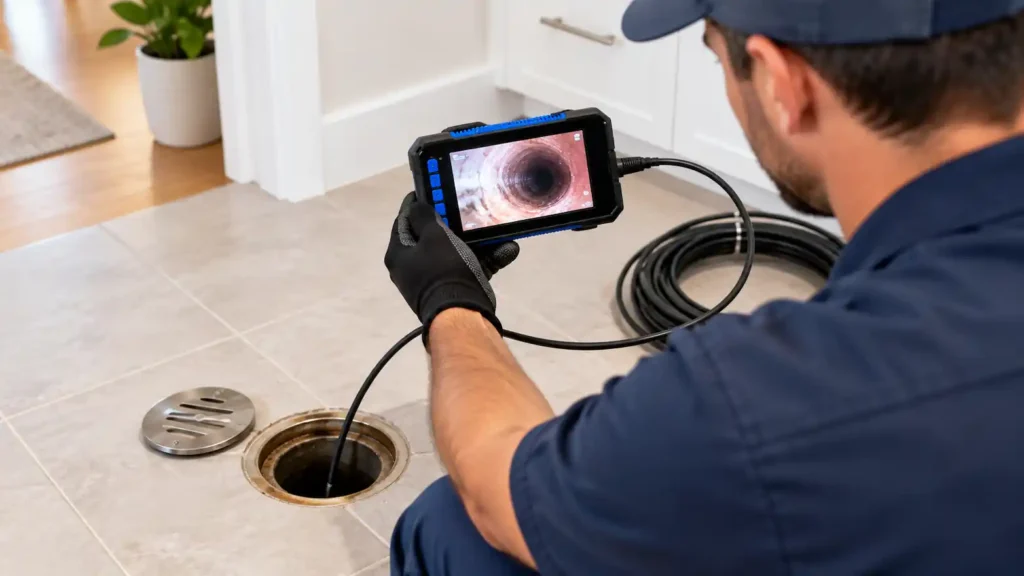
When neither surface method produces a result, entering the line through a removed toilet is the alternative that provides both location data and condition data in a single operation. A camera inserted through the floor connection maps the sewer line path, identifies cleanout positions and joint locations along the run, documents interior wall condition, and confirms where is my sewer line through direct visual documentation rather than surface inference.
What Camera Inspection Adds to Sewer Line Location
Camera inspection changes the answer to where is my sewer line is from a physical location to a complete service picture. The camera maps the path of the line as it travels through the pipe, but what it documents along the way is what determines whether the next step is cleaning, structural repair, or both.
For Austin properties where the sewer line has never been professionally inspected, that documentation regularly surfaces conditions that explain recurring drain problems that previous service calls addressed one episode at a time without identifying the shared source.
A main line that has been cleared twice in the same year with only temporary improvement may show a consistent grease layer across forty feet of pipe alongside a joint gap at one section that explains both the accumulation rate and the regrowth pattern after each clearing.
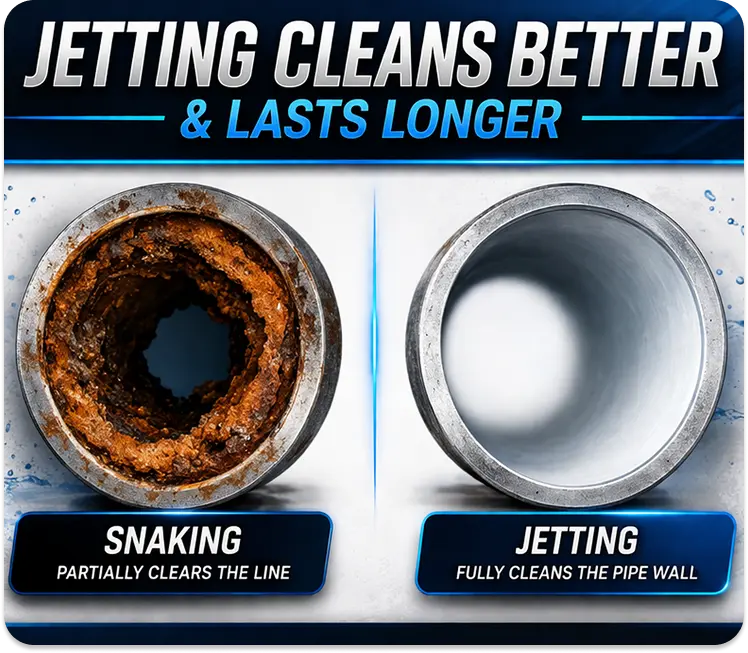
Our main line hydro jetting service integrates camera inspection into the diagnostic sequence before any high-pressure work begins because the cleaning approach that fits the pipe comes from what the camera documents, not from the most common assumption for the symptom category.
Where Is My Sewer Line: A Decision Framework for Property Owners
| Situation | First Step | Why It Matters |
| No visible cleanout, first drain issue | Probe or metal detect along foundation | Establishes access before scheduling service |
| Recurring drain problem after previous service | Camera inspection through cleanout or fixture | Reveals what previous services left in the pipe |
| Older property, unknown pipe material | Camera inspection before any cleaning | Confirms whether high-pressure cleaning is safe |
| Pre-purchase evaluation on older home | Camera inspection of full sewer lateral | Documents condition before ownership transfer |
| Multiple fixtures slow simultaneously | Camera inspection, main line focus | Identifies whether source is in main line or branch |
| Active backup at ground-floor fixture | Confirm cleanout access, camera before clearing | Prevents cleaning a structurally compromised pipe |
This framework answers the practical question of what to do first in each common scenario without requiring a professional on-site assessment to make the initial determination. Where is my sewer line is the prerequisite to every row in that table, and establishing the cleanout location before any of those situations becomes urgent is what keeps the diagnostic phase of any service call productive rather than consumed by access problems.
Where Is My Sewer Line by Construction Era in Austin
Austin sewer lines built in different decades carry different materials with different structural risk profiles and different accumulation patterns. Understanding where is my sewer line includes understanding what era the infrastructure represents, because that determines what cleaning approach is appropriate and what the realistic service outcome looks like.
Properties built before the 1960s in established Austin neighborhoods typically have clay tile or cast iron sewer lines with decades of mineral scale, grease accumulation, and joint movement from seasonal soil expansion and contraction. Those materials require camera confirmation of wall condition and joint integrity before any high-pressure cleaning, because a section with significant wall loss or a severely cracked joint responds differently to jetting pressure than intact pipe in good condition.
Properties built between the 1960s and early 1980s often carry a mix of cast iron at the main line level and early-generation PVC at branch connections. Those transition zones sometimes develop infiltration vulnerability at the material change points over time. Homes built after the mid-1980s carry predominantly PVC main sewer lines that handle jetting pressure well, accumulate scale and grease at a lower rate than older materials, and generally present a lower structural risk before cleaning.
What Accumulates Inside Austin Main Sewer Lines
Grease is the primary accumulation driver in Austin residential main sewer lines. It deposits on the pipe wall from the combined cooking and cleaning output of every connected fixture over years of household use, builds more slowly than in a kitchen branch drain, and coats a longer section of the pipe interior. A main line in a home with no professional cleaning history after ten or more years of occupancy carries a grease layer that reflects the full period of that use rather than a localized kitchen-level accumulation.
Mineral scale from Central Texas water chemistry adds a second layer to that grease accumulation and compresses the interval between restrictions by roughening the interior surface in a way that gives grease and organic material a more adhesive surface to bond against. Root infiltration from established plantings near the sewer corridor adds a third condition that is not visible from the surface and is only reliably confirmed by camera inspection before any cleaning begins.
The combined restriction profile of grease alongside scale and root infiltration is what most Austin main sewer line camera inspections find in properties without a professional main line cleaning history. That combination requires a cleaning approach calibrated to all three materials simultaneously rather than a generic service applied to one symptom category at a time.
Making the Right Main Line Decision for Your Austin Property
Understanding where is my sewer line is the first step in a sequence that ends with a service recommendation built on confirmed pipe condition rather than assumed cause. Locating the cleanout, tracing the line path, completing a camera inspection, and reviewing what the inspection documented before approving any scope of work is the sequence that makes every subsequent decision specific rather than generic.
Where is my sewer line as a question has a physical answer and a practical one. The physical answer is the buried pipe that runs from the building to the street. The practical answer is the current internal condition of that pipe, what it contains, what its wall condition supports, and what cleaning approach fits the specific combination of materials confirmed inside it. Camera inspection is what bridges those two answers and makes the service recommendation that follows worth acting on.
Contact EZ Hydro Jetting Austin to get a quote and a professional evaluation of the line condition behind your sewer line concern before committing to any service.